From 1772 to 1795, the Polish-Lithuanian Commonwealth was carved up three times:
- Prussian Partition (west) – Poznań, Gdańsk, Silesia. Records in German Gothic script.
- Austrian Partition (south) – Galicia, including Kraków, Lwów, Tarnów. Records in German or Latin.
- Russian Partition (east and center) – Warsaw, Białystok, Vilnius, Minsk regions. Records in Russian Cyrillic after 1868.
A child born in the same house in 1850, 1880, and 1910 could have three different "countries" on paper, without the family ever moving. The empire name is administration, not nationality.
2. What consulates actually look for
The Karta Polaka law does not ask for a document that says "Poland." It asks you to prove Polish ancestry from lands of the former Commonwealth.
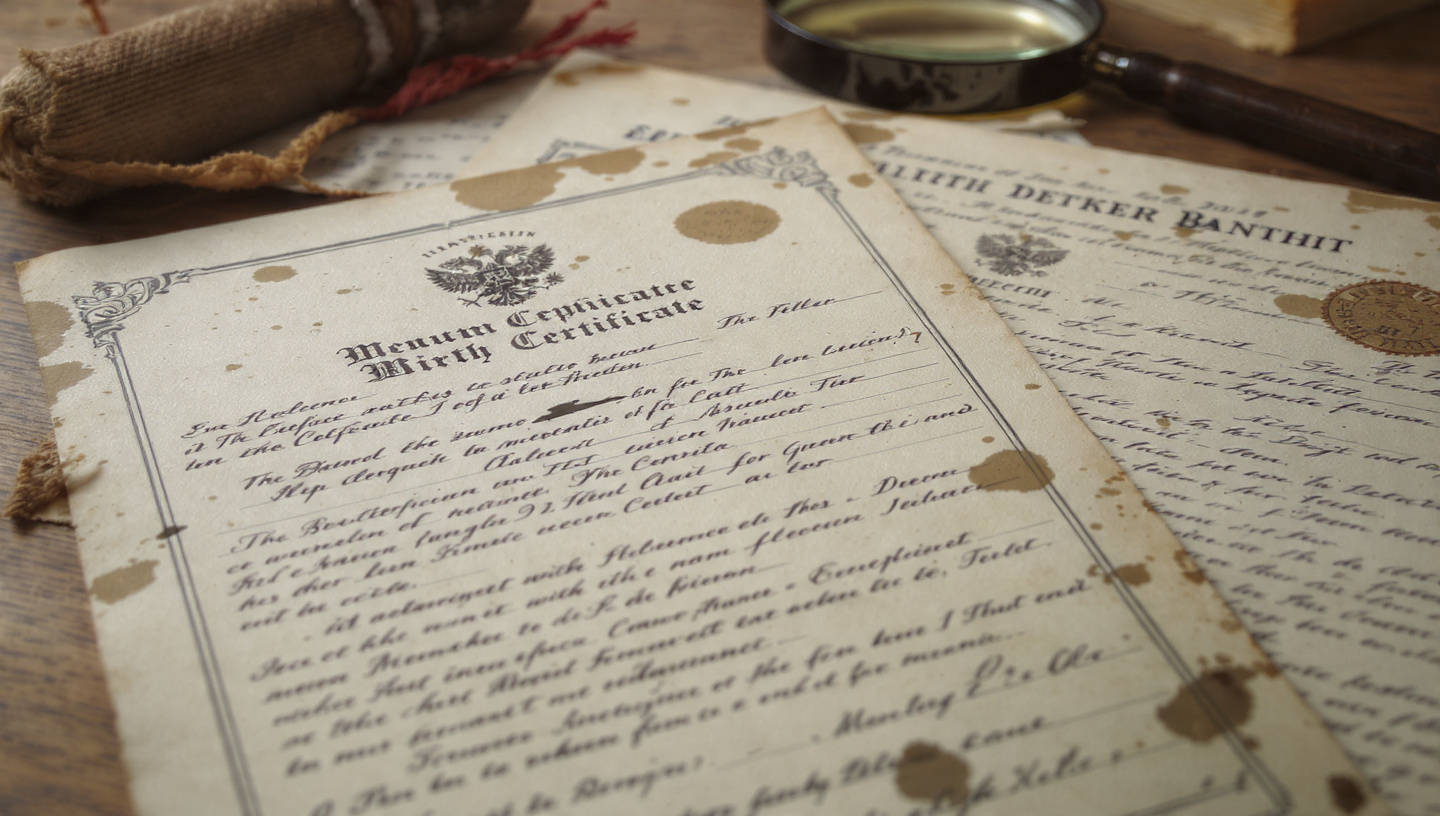
That means:
- A birth record from "Austria" in 1895 for a village near Kraków = valid, because Kraków was in Austrian Galicia but historically Polish.
- A marriage record from "Russia" in 1902 east of the Bug River = valid, if the parish was Polish Catholic.
- A German-language record from Poznań in 1888 = valid, because Poznań was under Prussia.
The key test is in our Basic Requirements — at least one Polish ancestor and active cultural connection. The paperwork's language proves where to look, not who you are.
3. How to decode your document in 3 steps
Step 1 – Find the exact village, not just the empire. Look past "Russia" to the parish name. Use gazetteers like Skorowidz or JewishGen Communities Database.
Step 2 – Place it on a partition map. Our Learn Poland Through Your Family Story guide includes the 1772 borders overlay. If your village was inside pre-partition Poland, you are on the right track.
Step 3 – Match the language to the partition.
- Cyrillic + double-headed eagle = Russian partition
- Gothic German + "Königreich Preussen" = Prussian
- Latin with "Galicia" = Austrian
This saves weeks of ordering the wrong archive copies. It is also the story you will tell in the interview.
4. What to say at the consulate
Officers hear this confusion daily. A strong answer sounds like:
"My great-grandfather was born in 1887 in Wola, recorded as Russian Empire. Wola was in Congress Poland, which was part of the Commonwealth before 1772. My family was Polish Catholic, and we kept Wigilia and Polish language at home in America."
That one sentence shows you understand history, not just genealogy. Practice phrasing like this in our Interview Prep section — basic Polish is enough, confidence matters more.
5. Common traps to avoid
- Don't translate the empire as nationality. "Austria" on a Galician record does not make your ancestor Austrian.
- Don't discard Latin records. Catholic parishes in all three partitions used Latin until the 1890s. They are often the most detailed.
- Don't rely on modern borders. Today's Belarus, Lithuania, and Ukraine contain hundreds of historically Polish villages. Check 1772, not 2026.
Next steps on kartapolaka.com.pl
- Gather Documents – use our checklist to order the right civil or church copy from the correct archive (Warsaw, Lviv, or Poznań branches).
- Check Eligibility – run the 2-minute quiz to confirm your line qualifies before you pay for translations.
- Study the context – the 30-Day Study Guide has a full module on partitions, with sample consulate questions and map drills.
When your story and your paperwork finally agree, your application gets much simpler. The contradiction was never in your family — it was in the map they were forced to live under.
Updated May 2026 • For deeper research, see the Polish State Archives (szukajwarchiwach.gov.pl) and the Library of Congress partition maps.