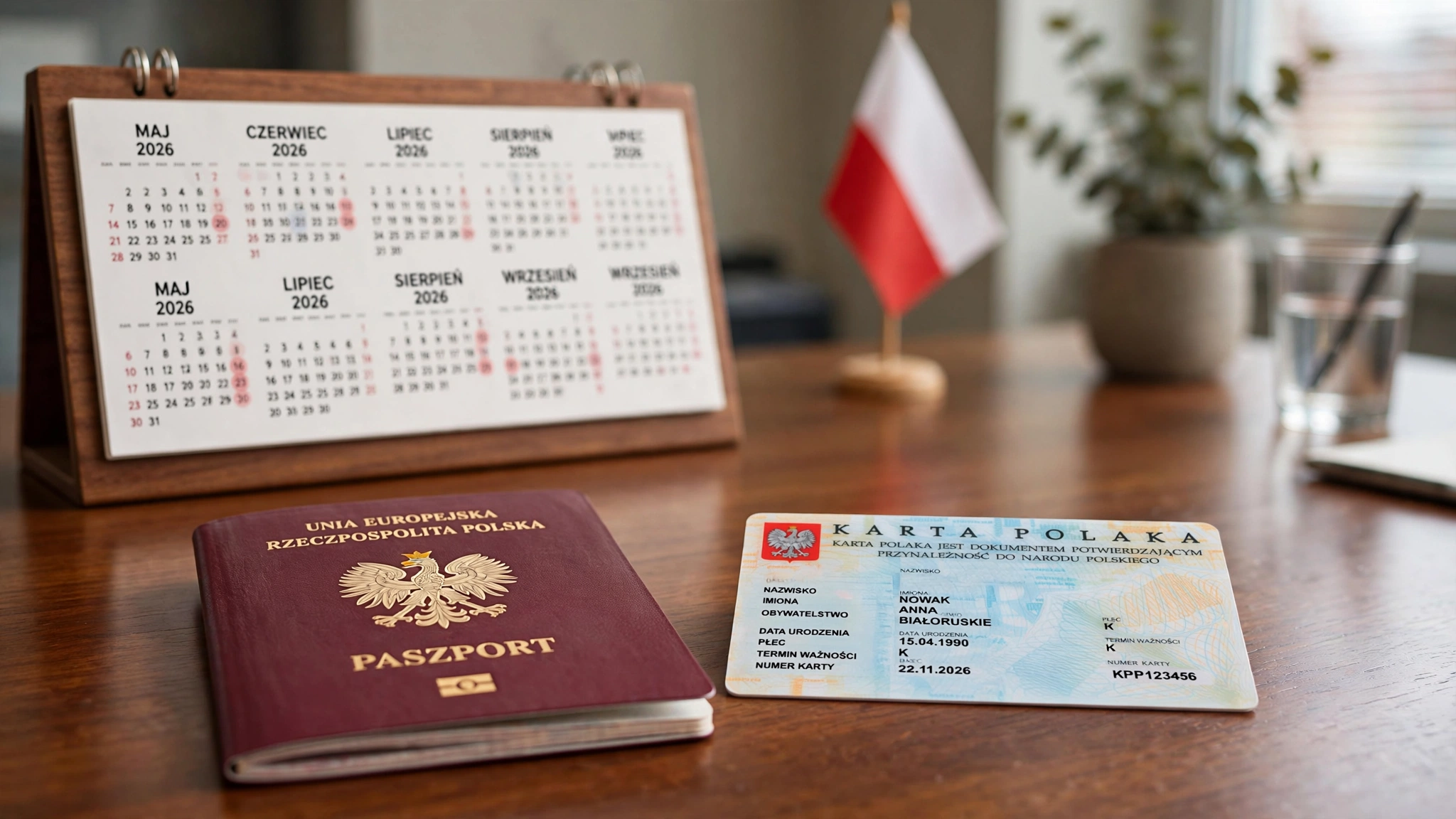
 Executive Timeline: What Is the Safest Planning Estimate?
Applicants should plan for about 3 to 6 months from the initial eligibility check to receiving the Karta Polaka[0]. The same planning window is mirrored in specialized resources for US-based applicants[18]. As that resource states: "The entire process of applying for the Karta Polaka from the United States takes an estimated timeline of three to six months, with document gathering generally being the longest step taking one to four months." These are planning estimates, not legal guarantees, because no statutory deadline governs consular processing of the Pole’s Card[0][18]. The major stages that make up this timeline—eligibility research, document gathering, appointment booking, the interview itself, the decision, and card receipt—each carry their own pacing, but by far the longest bottleneck is assembling the right paperwork.
This article walks through every phase so you can build a realistic calendar. It also highlights recent legal developments that could affect your application in 2026 and explains where the biggest scheduling risks lie, especially for applicants relying on diaspora organization certificates or trying to navigate America’s patchwork of consular booking systems.
Legal Foundation: What Is Karta Polaka and Where Does the Procedure Come From?
Karta Polaka—the Pole’s Card—is a document confirming your belonging to the Polish nation. Its statutory foundation is the Act on the Pole’s Card passed by the Polish parliament on September 7, 2007[15]. The law sets out who may apply, what evidence is required, and how the card is issued, but it does not prescribe a fixed processing deadline for consulates. That absence of a statutory clock is why all timelines discussed here are estimates drawn from practical experience rather than from the statute itself.
Because the sources do not quote the operative eligibility clauses, this article focuses on the timeline of the application process described by official guidance—from the first eligibility check to receiving the card[0]. For the exact substantive requirements, always consult the current statutory text and your consulate’s instructions.
Current Law and Recent Changes Affecting 2026 Planning
One historical change is well-sourced: a July 2019 amendment opened Karta Polaka to people of Polish origin in every country worldwide, including the United States and Canada[16]. Before that date, the card was largely limited to nationals of certain former Soviet republics. For US applicants, this means that ancestry anywhere in the Polish diaspora suffices, provided the other legal criteria are met.
More immediately relevant to 2026 planning is a draft bill proposed in February 2026 by Poland’s Ministry of Foreign Affairs[17]. If enacted in its current form, the bill would eliminate the possibility of obtaining the card through certificates from Polish diaspora organizations and would introduce a mandatory application fee[17]. At the time of writing, the bill remains a proposal; it is not current law. Any timeline you map out should therefore account for the possibility that either the document pathway or the fee structure could change mid-application. Applicants who intend to rely on diaspora organization certificates should monitor whether the bill has passed before investing time in that document route.
Stage 1 — Eligibility Screening and Ancestry Theory
Eligibility screening sits at the very beginning of every timeline. The official walkthrough starts from the first eligibility check[0], so this phase is built into the 3–6 month window. There aren't isolated fixed number of days or weeks for screening because the complexity varies wildly: an applicant with a well-documented single line of descent may confirm eligibility in days, while someone reconstructing a fragmented family tree can spend many weeks just researching.
For US applicants, the worldwide expansion of the program means that Polish origin anywhere in the family line is sufficient[16]. However, the source pack does not provide the exact statutory ancestry formulas, so the article cannot list precise relationship degrees or generation limits. Your screening should answer two practical questions: can you produce documentary evidence of Polish origin, and do you meet the additional requirements the law imposes? Once those answers are clear, you can move to gathering the actual paperwork.
Stage 2 — Document Gathering: The Likely Longest Bottleneck
Document gathering generally takes 1 to 4 months and is described as the longest step in the whole US process[18]. That range is not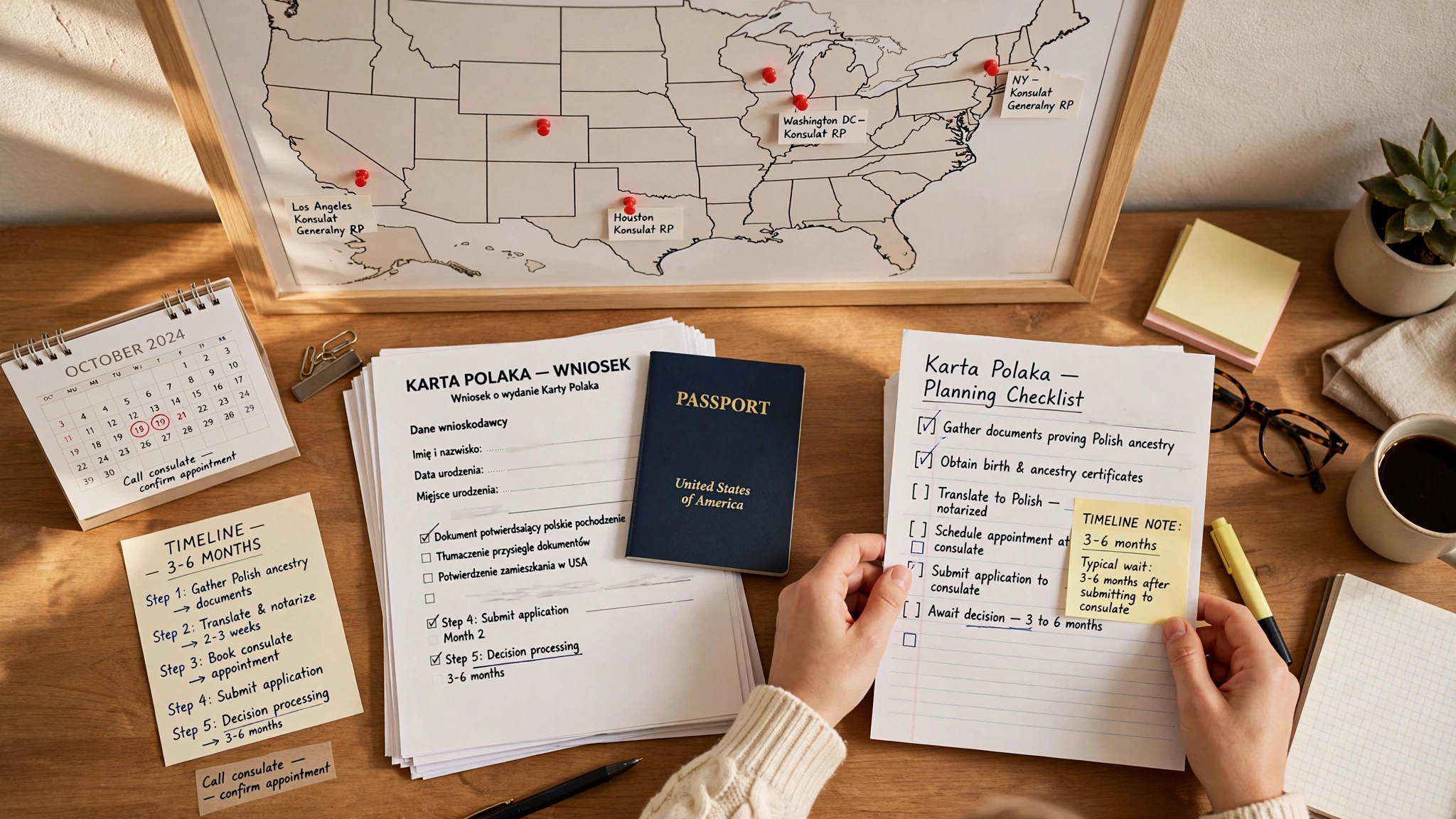 arbitrary: it reflects the time needed to request vital records from state and church archives, obtain Polish-language translations, and verify that each document matches the consulate’s current requirements. The 1–4 months sits inside the overall 3–6 month estimate, meaning that if your file comes together quickly, the remaining stages can often be squeezed into a tighter window; if gathering drags on, it consumes most of the available time.
Because official Karta Polaka document checkists are not public, the article cannot publish a bullet-point list of every required paper. However, the practical advice is clear: assemble identity and eligibility evidence, then verify every item against the instructions published by the consulate that will handle your application[18][19][20]. Do not import document lists from visa-related sources, since those cover different legal requirements. For instance, a typical visa application checklist might include: "Prepare the necessary documents: application form, travel document (passport), biometric photo, health insurance, sufficient means to support yourself, documents confirming the purpose of your stay[6]." This list is not applicable to Karta Polaka. Applicants who plan to rely on certificates from Polish diaspora organizations should also track the February 2026 draft bill: if it passes, that document strategy may disappear[17].
Stage 3 — Choosing the Consulate and Booking the Appointment
Appointment mechanics are consulate-specific, and documentation gives two clear but opposing examples. At the Consulate General in New York, Karta Polaka appointments must be reserved by email or by phone[19]. At the Consulate General in Chicago, registration is completed online through the e-Konsulat system[20]. These differences mean you cannot assume a single nationwide procedure; even if your documents are ready, the booking channel itself may add a layer of planning complexity.
The practical risk is that an applicant who expects an instant e-Konsulat slot in New York will be frustrated by the email/phone requirement, while a Chicago-area applicant searching for a phone number will waste time instead of logging onto the electronic platform. Before committing to a timeline, identify which consular district covers your residence, and then confirm the current booking method directly from that consulate’s official website.
Stage 4 — Interview Preparation and Appointment Timing
Interview preparation fits within the overall 3–6 month estimate; it is not a standalone fixed-length stage[18]. There are interview-preparation resources, but they do not quote specific questions, language proficiency thresholds, or pass/fail scoring criteria. For that reason, this article does not invent official interview standards. Instead, consider preparation as the bridge between booking the appointment and attending it. During this period, you can review your family history, practice speaking about your Polish heritage, and ensure you can present the documents you assembled. A very good resource for karta polaka interview studying is found at kartapolaka.com.pl.
The timing of the appointment itself depends on the consulate’s availability. The source pack does not supply current wait times for US posts, but the appointment-reservation mechanics described above[19][20] suggest that some consulates may fill slots quickly. Building flexibility into your calendar after document gathering can prevent unnecessary stress if the first available interview date is weeks away.
Stage 5 — Decision, Card Issuance, and Receipt
The official process walkthrough ends with receiving the card[0]. However, the source pack does not provide a specific post-interview issuance period, so the article cannot state a fixed decision deadline. The safest planning assumption is that the time between the interview and physically holding the card remains within the total 3–6 month estimate[0][18]. Some applicants receive a decision on the spot, while others wait weeks for administrative processing.
If you are creating a visual timeline, mark this final stage as variable rather than fixed. Until you experience it firsthand, treat the decision-to-receipt interval as a buffer that allows the overall process to finish within the planned window, not as a predictable number of business days.
Timeline Scenarios: Fast, Typical, and Delayed Cases
Every application sits somewhere on a spectrum. There are three broad patterns, each still falling inside or near the 3–6 month planning envelope.
Fast case: A well-prepared applicant with straightforward Polish lineage and ready access to original records may complete everything closer to the 3-month mark. The source pack does not promise a shorter absolute minimum, but 3 months is a realistic floor when no unexpected obstacles arise[0][18].
Typical case: The modal experience is 3–6 months total, with document gathering consuming 1–4 of those months[18]. This scenario assumes a manageable number of documents, a reasonable appointment wait, and no major consular backlogs.
Delayed case: Delays most often trace back to document gathering, simply because that is the longest step[18]. Additional friction can come from appointment-channel variation—New York’s email/phone system versus Chicago’s e-Konsulat may affect scheduling speed[19][20]—or from peak-season congestion. A delayed case might still finish within 6 months, but it tests the upper boundary of the planning window.
A summary table of supported planning ranges follows:
Total process: 3–6 months[0][18]
Document gathering: 1–4 months[18]
These ranges are drawn directly from the source pack and do not reflect any statutory processing deadline.
If Something Goes Wrong: Refusal, Missing Documents, or Delay
An administrative refusal or a request for additional evidence can prolong the timeline, but the source pack does not provide appeal deadlines, appeal authorities, or a step-by-step refusal procedure under the Act on the Pole’s Card[15]. The article can safely state only that the Pole’s Card is grounded in that statute, and therefore any challenge or reconsideration process should be checked against both the law itself and the consulate’s official guidance[15][19][20].
Do not assume that general Polish administrative procedure applies without verifying it against the Pole’s Card law. For timeline planning, the most concrete advice is to build in contingency time. The 3–6 month estimate is exactly that—an estimate, not a guaranteed deadline[0][18]. If a request for missing documents arrives, your total timeline will shift right, so plan for that possibility from the start.
Reapplication or Restarting After a Weak File
The source pack does not state formal reapplication rules, waiting periods, or whether a new appointment is required when a prior application fails[15][19][20]. What it does provide is practical insight: if documents were the bottleneck, improving the evidence file becomes the main timing issue, because document gathering is generally the longest step and may require 1–4 months even on a second attempt[18].
If a reapplication involves changing consular districts, appointment mechanics may shift. An applicant who moved from New York’s email/phone system to Chicago’s e-Konsulat, or vice versa, should re-verify the booking procedure[19][20]. Reapplication after legislative changes—particularly if the February 2026 draft bill becomes law—also demands a fresh look at whether diaspora organization certificates remain acceptable and whether a mandatory fee now applies[17].
Practical 2026 Planning Checklist and Calendar
Use the following checklist to structure your own calendar. Every item is anchored to a source-supported fact, but always cross-check with your consulate’s current instructions before taking action.
1. Set a 3–6 month planning window for the complete process[0][18].
2. Reserve 1–4 months for document gathering[18].
3. Confirm the appointment method for your consulate: New York requires email or phone[19]; Chicago uses e-Konsulat[20].
4. Check the status of the February 2026 draft bill before relying on diaspora organization certificates or assuming no fee is required[17].
5. Do not substitute visa document checklists for Karta Polaka requirements[6].
6. Verify official consular instructions immediately before filing[19][20].
By working through this list, you give yourself the best chance to stay within the 3–6 month window and to absorb surprises without derailing your application.