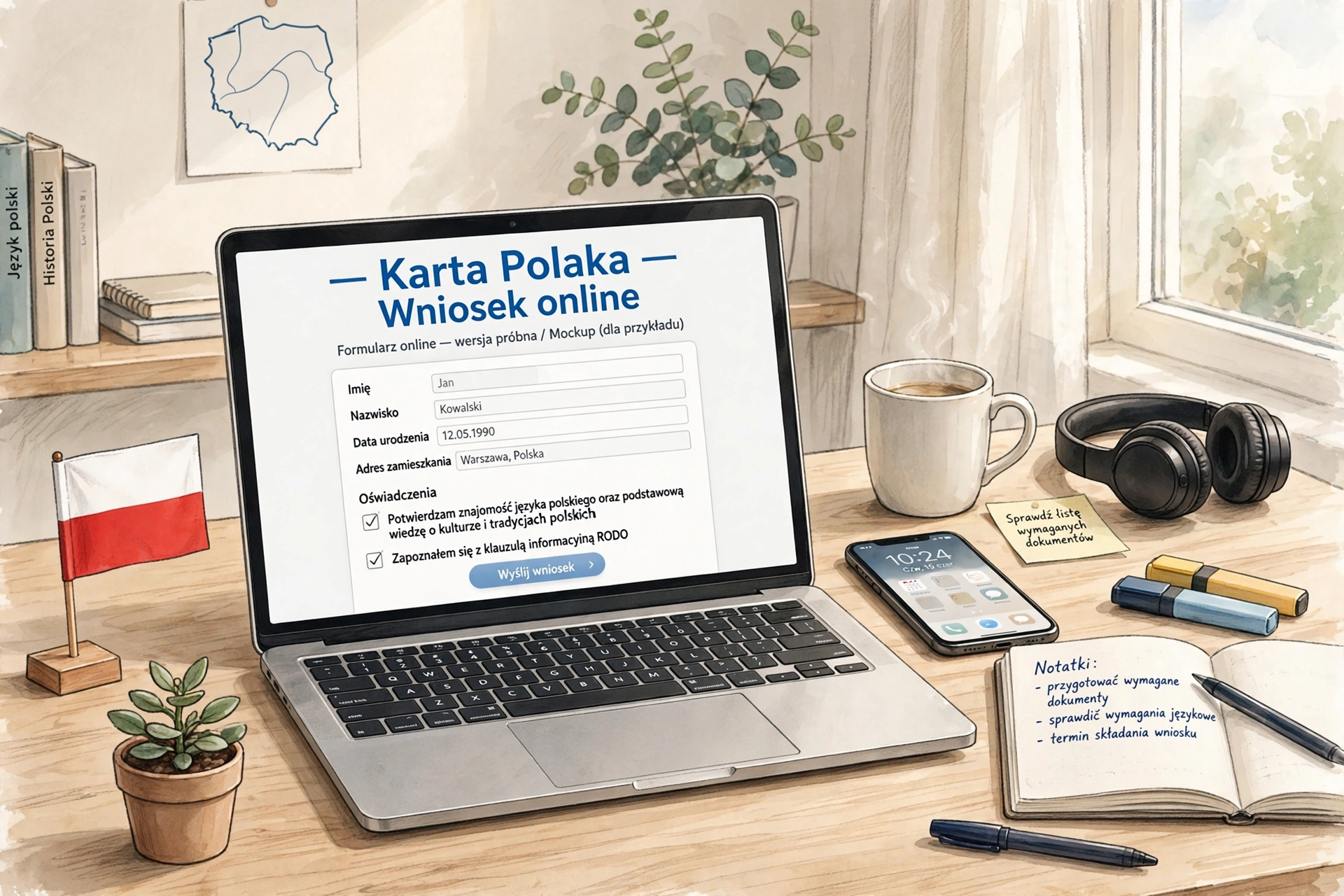
 1. What the Karta Polaka Is—and What It Is Not
The Karta Polaka (Pole’s Card) is a document confirming belonging to the Polish nation.[0] It is designed for individuals who cannot obtain dual citizenship in their own countries while meeting the legal conditions of belonging to the Polish nation.[0] This point causes constant confusion: the card does not grant Polish citizenship, nor is it a Polish passport or travel document. It opens certain rights in Poland, such as visa‑free entry, access to education, and a path to permanent residence, but it remains a separate status entirely. Many applicants mistakenly believe the card automatically leads to citizenship; in reality, it is a stepping stone that must be combined with other legal requirements.
Understanding this distinction is the first practical step when your application is refused. A consul or voivode is not denying you citizenship; they are ruling that you have not met the statutory conditions for the card. Your next move depends on which specific condition the authority says you failed to meet.
2. Who Decides the Application: Consul or Voivode
The Karta Polaka is granted by decision of a Polish consul if you reside outside Poland, or by a voivode (a Polish province governor) if you already reside in Poland.[1] The refusal letter will therefore come from one of these two authorities. Most applicants apply through a consulate, and this article focuses on consular refusals. However, the principles of reading the decision, appealing, and reapplying apply broadly to both paths, though appeal routes may differ slightly. For those already in Poland, the voivode’s office (urząd wojewódzki) processes the application and uses a similar administrative framework, but due to overlapping jurisdiction with residence permits, the context can be more complex. Always check the decision itself for the exact appeal instructions.
3. The Core Eligibility Requirements Behind Most Refusals
Three requirements cause the majority of Karta Polaka refusals. First, you must demonstrate documented Polish ancestry or active involvement in Polish culture.[2] Second, you must show basic Polish‑language ability.[2] Third, you must attend an in‑person interview before a Polish consul, where you will be questioned in Polish about your ties, family, and knowledge of Polish traditions.[2]
Refusals often arise because the documentary evidence is weak, the applicant’s spoken Polish is insufficient, or the interview reveals that the person cannot really engage with Polish culture in a meaningful way.[2] Consuls typically assess language and cultural awareness during a 15‑to‑20‑minute conversation. If you cannot hold a simple conversation or do not know basic facts about Poland, such as describing a popular holiday like All Saints’ Day or naming the capital and major historical landmarks, your application may be refused even if your paperwork is in order. This holistic evaluation means both the paper trail and personal presentation matter equally.
4. Statutory Refusal Grounds: What Can Be Safely Said from the Sources
The Act on the Pole’s Card (Dz.U. 2007 No. 180 item 1280, as amended) lists a closed set of refusal grounds. The source pack for this article does not reproduce the full article, but we know that a refusal can be based on failure to meet the eligibility prerequisites and the occurrence of one of the specific causes mentioned in the law.[7] In the precise words of the statute, it is a case of "niespełnienie przesłanek oraz wystąpienie jednej z przyczyn z art." — failure to meet the prerequisites and occurrence of one of the causes from the article. Those causes include false statements, security concerns, or activities against Poland. The practical take‑away: do not assume you were refused for a generic reason. The written decision will cite the exact legal provision and the facts supporting the refusal.
Many applicants guess the reason and prepare a new application without fixing the real problem. This prolongs the process and frustrates consular staff. Instead, treat the refusal decision as your primary diagnostic tool.
5. Official Procedure and Documents: What the Applicant Must Prove
The application process requires you to submit documentary evidence of your Polish ties, demonstrate language proficiency, and attend an interview. All activities connected with submitting a Karta Polaka application are free of consular fees,[10] though you may still incur costs for translating documents, obtaining certified copies, or legal advice. The official portal also specifies that "Osoby ubiegające się o wydanie Karty Polaka ze zmienionymi danymi osobowymi składają:" (those applying with changed personal data submit) additional documentation, such as proof of name change, so even minor personal data updates must be carefully addressed.
Examples of documents that can support your claim include birth certificates of Polish parents or grandparents, baptism records, and other historical documents that establish a link to Polish nationality.[6] Remember that the consul evaluates the overall picture: a few old papers might suffice if your language and cultural knowledge are strong, but weak language and weak documents can lead to refusal. While this guide focuses on the Karta Polaka, similar document-gathering rigor applies to other permits. For instance, Karta Pobytu rejections often cite other common missing documents include: proof of health insurance (ZUS payments or private insurance confirmation).[5] This serves as a stark reminder to compile all required paperwork meticulously. The interview is often the decisive moment, so preparing to speak Polish about your family history and Polish traditions is essential.
6. Reading the Refusal Decision: Do Not Guess the Reason
In Polish administrative practice, as one guide aptly notes, a refusal decision acts as a map of the authority’s reasoning.[8] What the refusal decision actually tells you: a refusal decision from the urząd wojewódzki isn't just a 'no' — it's a map.[8] This principle holds true no matter which authority issued your denial: the decision will state the legal grounds and the factual findings that led to refusal.
Compare the reasons with the three core eligibility elements.[2] Was the issue a missing great‑grandfather’s birth certificate? An interview where you could not answer questions about Polish holidays? A declaration that the consul found unconvincing? Separating fixable evidence problems from legal findings that may require an appeal is the first step toward a successful next move.
7. Appeal After a Karta Polaka Refusal: Deadline and Route
Ukrainian language resources summarize the appeal option succinctly: "варіант 1: оскарження (odwołanie) закон надає 14 днів з дати отримання офіційного рішення." Option 1: Appeal. The law grants 14 days from the date of receiving the official decision.[9]
You have 14 days from the date of receiving the official decision to file an appeal. The appeal is submitted to the Minister of Foreign Affairs of the Republic of Poland. The appellate authority reviews the case exclusively on the basis of the existing case materials.[9]
This short deadline makes it critical to review the refusal letter immediately. The appeal must be in writing, in Polish, and submitted through the consul who issued the decision. Because the review does not consider new documents, the appeal must argue that the consul made an error on the facts already in the file or misapplied the law. It is strongly recommended to draft a precise legal argument rather than an emotional plea, and consulting a specialist in Polish administrative law can make a significant difference.
If you miss the 14‑day window, the decision becomes final. There is no second chance to appeal the same refusal, though you remain free to submit a new application (see Section 9).
8. Appeal Strategy: When an Appeal Makes Sense
An appeal is your best tool when you are convinced the authority misunderstood your documents, wrongly evaluated your interview, or applied the legal requirements incorrectly.[5][7] For example, if the consul dismissed a valid birth certificate because the seal was unclear or questioned your Polish because you hesitated while nervous, an appeal can point out the error. Because the file is already closed, your appeal letter must be precise, referencing the documents and statements already on record.
An appeal is not the right path if you simply lacked evidence. If you now have a stronger document or have improved your Polish, that will not be considered on appeal. In that situation, a reapplication with the new evidence is the correct route. Remember that the 14‑day deadline is absolute and cannot be extended; if the appeal is successful, the consul or Minister may reverse the decision and grant the card. If rejected, the decision becomes final, though in some cases judicial review before an administrative court remains an option. Choosing the wrong path costs time and may weaken your credibility with the authority.
9. Reapplication After Refusal: What Must Change
What to Do If Your Application Gets Rejected
Reapplying is a fresh attempt to satisfy the same eligibility requirements. There is no waiting period prescribed by law, and you may submit a new application as soon as you are ready.[9] However, consular practice acknowledges that filing repeatedly without new evidence prolongs the procedure and rarely leads to a different outcome. A strong reapplication directly addresses the reason for refusal stated in the original decision.
If the refusal was based on insufficient ancestry documentation, gather birth certificates, baptism records, or other historical documents.[6] If language was the issue, take Polish classes, use online preparation courses, practice with a native speaker, and be prepared to speak continuously during the interview. If the consul doubted your cultural ties, arm yourself with deeper knowledge of Polish traditions, holidays, and the modern community you are part of. The second attempt should be visibly stronger, not just a repeat.
10. Current Law in 2026 and Recent Amendments: What the Sources Do—and Do Not—Show
As of late July 2026, the Karta Polaka procedure is still governed by the 2007 Act.[0][1] While broader Polish immigration law has seen several changes in 2025 and 2026,[9][11] none of the source materials available for this article prove a direct amendment to the Karta Polaka refusal, appeal, or reapplication rules. To give context, one analyst observed that "during the ten years or so prior to 2025, the system was largely reactive, dealing with labor shortages or humanitarian crises as they appeared."[11] This reactive stance has spurred numerous reforms, but not all impact the Karta Polaka. For example, Karta Pobytu applicants have seen changes that some call "the biggest procedural change of 2026,"[13] such as mandatory electronic submissions. Do not assume that updates to residence permits, employment rules, or the Karta Pobytu automatically alter the Pole’s Card process. Before taking action, always verify the current official text and the latest Gov.pl guidance, especially if you are relying on a recent legislative development.
11. Practical Checklist Before Appealing or Reapplying
1. Confirm who issued your decision. Was it a consul or voivode, and note the date you received it.
2. If appealing, mark the 14‑day deadline on a calendar. The appeal must reach the consul in time; postal delays are your risk.
3. Identify the exact refusal reason by reading the legal basis and factual justification in the decision letter.
4. Check whether your file already contains enough evidence of Polish ancestry or active cultural involvement.[2][4] If not, an appeal will fail.
5. Honestly assess your Polish‑language ability and interview readiness. Could you discuss your family history and Polish traditions without preparation? If not, reapplying with better language skills may be wiser than an appeal.[2]
6. Prepare stronger ancestry or cultural activity evidence where relevant. Birth certificates of Polish parents or grandparents, baptism records, and historical documents are commonly used examples.[6] All documents should be translated into Polish by a sworn translator if not already in Polish.
7. Remember that Karta Polaka application related actions are free of consular fees,[10] but you must cover any translation or notary costs yourself.
8. Do not rely on residence card or employment law changes to fix your Karta Polaka case unless a confirmed amendment applies.[9][11] When in doubt, consult the consulate or a qualified advisor.
9. If you are considering family reunification plans, note that different permits have different rules. For example, for repatriation, "Yes. A spouse and minor children may relocate together with the main applicant."[14] However, Karta Polaka does not automatically grant the same rights; check the specific rules for your category.