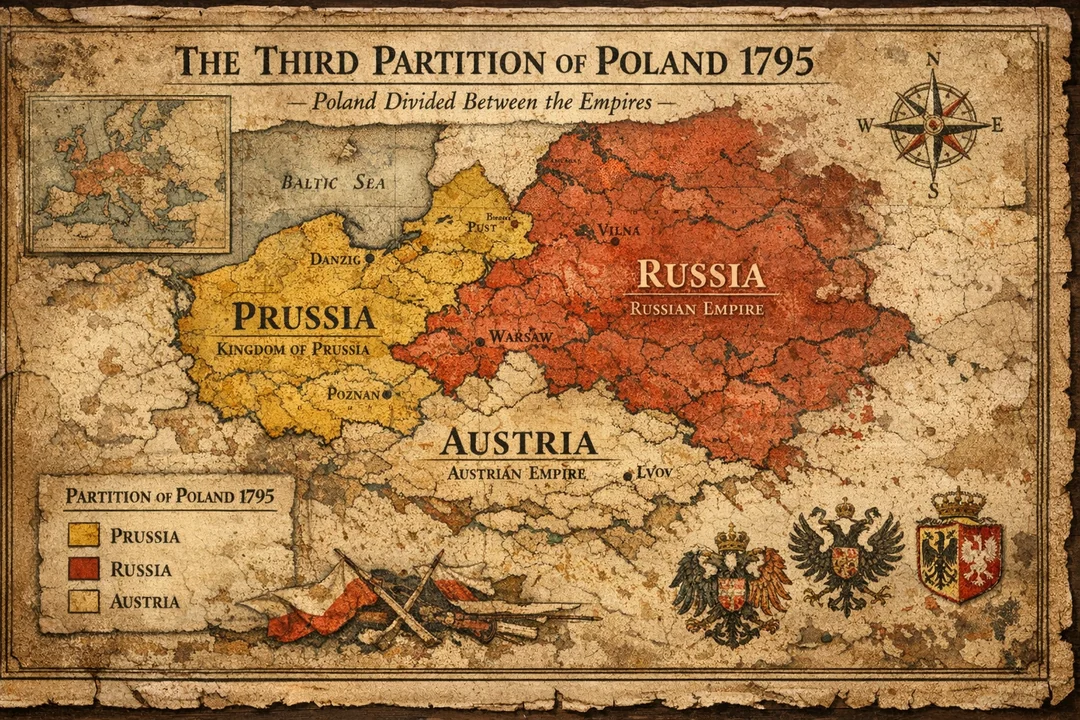
 If you have ever dug through old family papers and found a birth certificate that lists your great-grandfather's birthplace as "Russia" or "Austria" — even though the family always said they were Polish — you are not alone. Between 1772 and 1918, the Polish-Lithuanian Commonwealth was partitioned three times by the Russian Empire, the Kingdom of Prussia (later Germany), and the Habsburg Austrian Empire. Poland simply did not exist as an independent country on any map. A family could live in the same village for over a hundred years, yet their official birth, marriage, and death records would be written in Russian, German, or Latin, depending on which empire controlled that territory at the time.
This is not just a historical curiosity — it directly affects your Karta Polaka eligibility. When you apply, you need to prove your Polish ancestry through documents that show your ancestors were Polish nationals or lived in Polish lands. But what counts as a "Polish land" during the partitions? The answer is: the territory that was part of the Polish Commonwealth before 1772. So a birth record that says "born in the Russian Empire" in 1880 can still be valid proof — if the village was historically Polish. The key is to recognize that the empire listed is just the occupying power, not the nationality of your family. Many applicants get stuck because they assume a Russian-sounding document means their ancestor was Russian, but that is almost never the case for ethnic Poles living in the eastern provinces.
To navigate this, you will need to identify the exact village and then check which partition it fell under. Our genealogy research guide can help you trace your family back to the right parish and understand the shifting borders. For example, a village near Kraków was part of the Austrian partition (Galicia), so records there were kept in German or Latin. A village east of the Bug River was under Russian rule, with records in Russian Cyrillic. And a village in the west, like Poznań, was in the Prussian partition, where German was the official language. Knowing this saves you time and frustration when searching through archives or ordering copies from civil registry offices. It also prepares you for the consulate interview, where you may be asked to explain how you know your ancestor was Polish despite the foreign paperwork.
Once you have gathered your documents, the next step is to present them clearly. During your consulate visit, the officer will examine each record to confirm it comes from Polish territory. If you can confidently say, "My grandfather was born in 1895 in the village of X, which was part of the Russian partition, but he was Polish," you demonstrate a solid understanding of your heritage. That kind of preparation — linking history to your personal story — is exactly what makes a strong application. For extra help, the paid 30-Day Study Guide includes modules on historical context and document interpretation, so you walk into that interview ready to connect the dots.