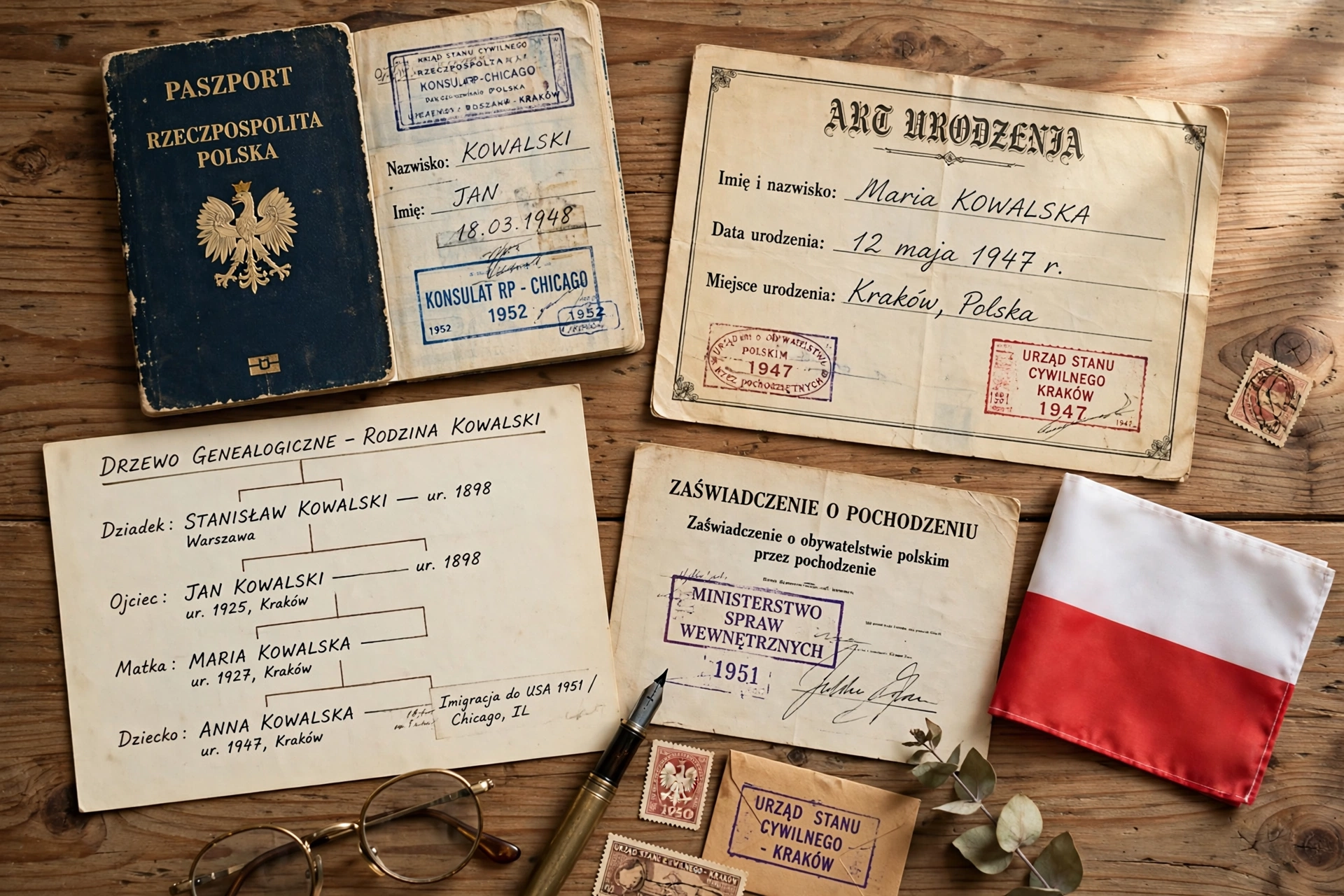
 The Austria Mystery in Your Family History
Many families uncover ship manifests, census records, or naturalization papers that list 'Austria' as a birthplace. This label is not a mistake; it reflects the political entity that controlled the region when your ancestors left. The area most often involved is historic Galicia, a crownland of the Austrian Empire that straddles modern Poland and Ukraine.[0] Immigration officials were recording current jurisdiction, not ethnicity, and the instructions they followed often demanded the sovereign state of allegiance.
For Polish genealogy, 'Austria' almost never means the modern republic of Austria. It points to the Austrian partition of Poland—a region known as Galicia and Lodomeria, which encompassed major Polish cities like Kraków and Przemyśl, and Ukrainian cities like Lviv (Lwów).[0] After World War II, the border shifted dramatically, splitting Galicia between Poland and the Soviet Union (now Ukraine). Today, vital records for the very same family can sit in archives on both sides of the border.[0]
A Brief History of Galicia and the Austrian Partition
In the late 18th century, Poland was partitioned by Russia, Prussia, and Austria. The Austrian share—called the Kingdom of Galicia and Lodomeria—existed from 1772 until the collapse of the Austro-Hungarian Empire in 1918.[0] Galicia encompassed a vast territory, including the cities of Kraków, Lviv, and Przemyśl, and millions of ethnic Poles, Ukrainians, and Jews lived under Austrian rule.
After World War I, Poland regained independence and most of Galicia became part of the Second Polish Republic. However, following World War II, the border was redrawn again: the western part stayed with Poland, while the eastern part—including Lviv—was annexed to Soviet Ukraine. As a result, what was once a single administrative unit is now divided between two modern states.[0] This split means that historical records for a village that was once in Austrian Galicia might now be held in a Polish state archive, a Ukrainian archive, or even a church repository, depending on its location today.
Why Your Ancestors Wrote 'Austria' … and Swore Loyalty to an Emperor
U.S. immigration and naturalization forms required precise political allegiance, not ethnic identity. In naturalization petitions before United States courts, applicants from the Austro-Hungarian Empire were required to formally renounce all allegiance and fidelity to Francis Joseph, Emperor of Austria and Apostolic King of Hungary.[2] So when your ancestor swore loyalty to the Austrian emperor, it was a legal necessity—not a statement of their nationality.
Similarly, ship manifests and census enumerators often recorded the country of origin as 'Austria' simply because that was the recognized sovereign power at the time of emigration. These documents are direct artifacts of the political landscape that existed before Poland regained its place on the map. The appearance of 'Austria' on your family’s papers is therefore a gateway to understanding the region they really came from, not a dead end.
Pinpointing the Exact Locality: The Key to Your Karta Polaka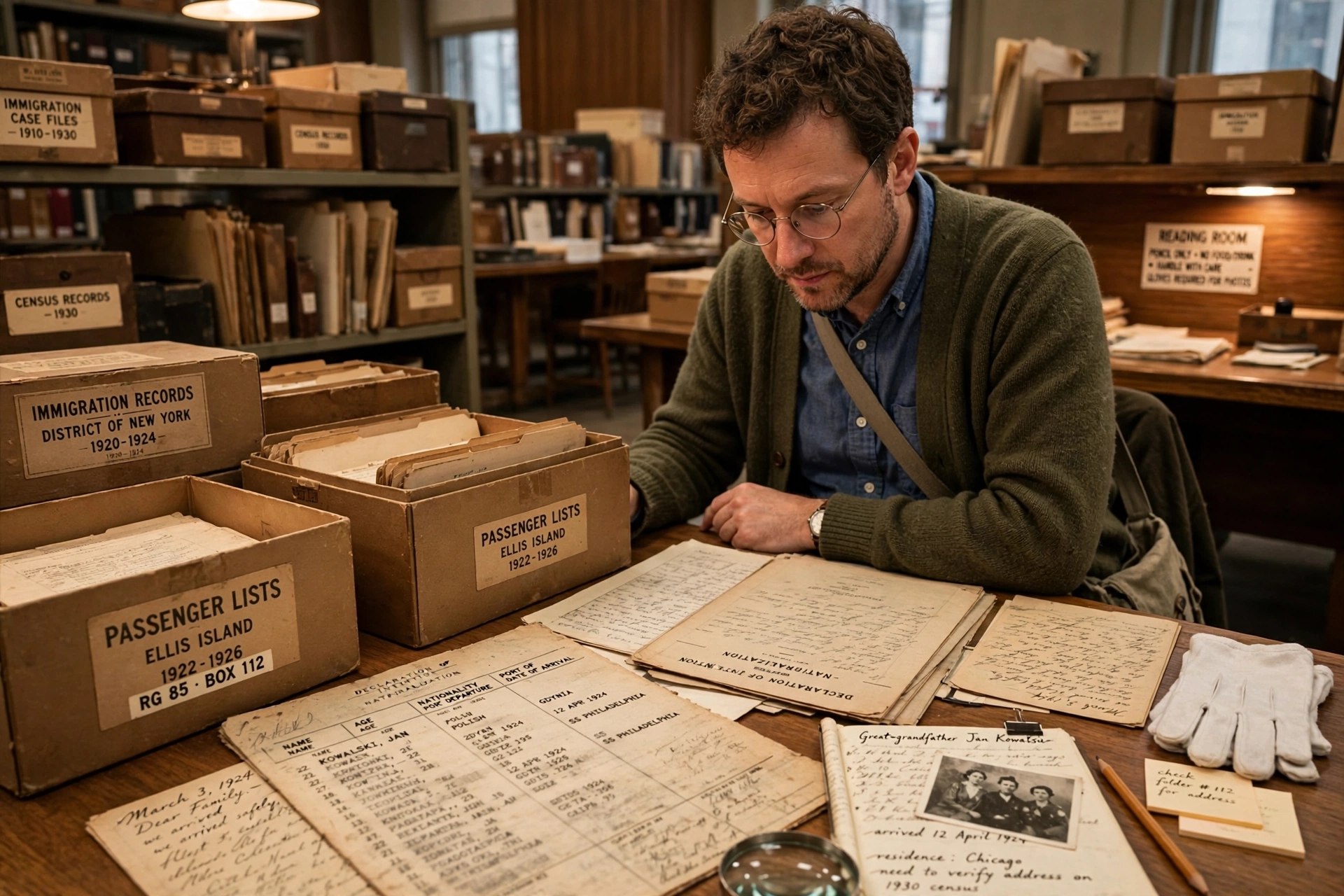
Because borders shifted repeatedly, knowing only 'Austria' or 'Galicia' is not enough to proceed with a Karta Polaka application. Polish citizenship by descent hinges on proving a connection to a specific ancestor who was a Polish citizen or resided in a recognized Polish territory. To locate ancestors from Austrian Poland, you must know the specific village where your family lived, as border changes frequently altered regional jurisdictions.[1]
Online gazetteers, historical maps, and community databases can help you match old place names to modern jurisdictions. Once you know the precise locality, you can determine whether today’s repository is a Polish state archive or a Ukrainian one—or whether the records survive at all. Since Galicia’s administrative boundaries changed frequently, even within the Austrian period, cross-referencing multiple sources is essential to be sure you’re searching the correct archive.[1] A birth recorded in a parish that now lies in Ukraine might still prove Polish ancestry if the family was ethnically Polish, but expect additional steps like translation and authentication.
Translating History into Documents for Your Pole's Card
The Karta Polaka application process requires original vital records—birth, marriage, or death certificates—that prove your Polish lineage.[3] Secondary sources, oral family histories, and U.S. documents that say 'Austria' are not sufficient on their own. You must obtain certified copies from the appropriate archive or civil registration office, whether that is in Poland or Ukraine.
If your records are in Ukrainian, German, or another language, they must be accompanied by a sworn translation into Polish, certified by a sworn translator listed with the Polish Ministry of Justice.[3] Plan ahead: locating the right archive, ordering copies, and arranging certified translations can take weeks or months. Recognize that 'Austria' on your great-grandfather’s naturalization papers is not the final answer—it is the beginning of a targeted search for the village and the vital records that will satisfy the consular officer.