Language can fade over generations, but customs often stay
Your great-grandparents may have arrived speaking only Polish. By the third generation, English dominates the kitchen table. That is normal in America. What survived the crossing was not grammar, it was practice: what you cook on December 24, what you carry to church on Holy Saturday, how you welcome a stranger.
Polish-American folklorist Deborah Silverman calls this "Polonia without walls" — a culture that stayed distinctive even after families left the old neighborhoods, because it adapted rural peasant traditions to urban American life rather than freezing them.
Why food outlasted the mother tongue
In Hamtramck, Detroit's historic Polish enclave, shop owner Magdalena Srodek put it plainly:
"When the Polish came over, many were forced to assimilate into American culture. The biggest thing is the loss of language — it's why you see people who are older start taking Polish classes... The loss of language may happen, but people will never abandon their food. It's been passed down for generations, and it's not going away, no matter where people may live."
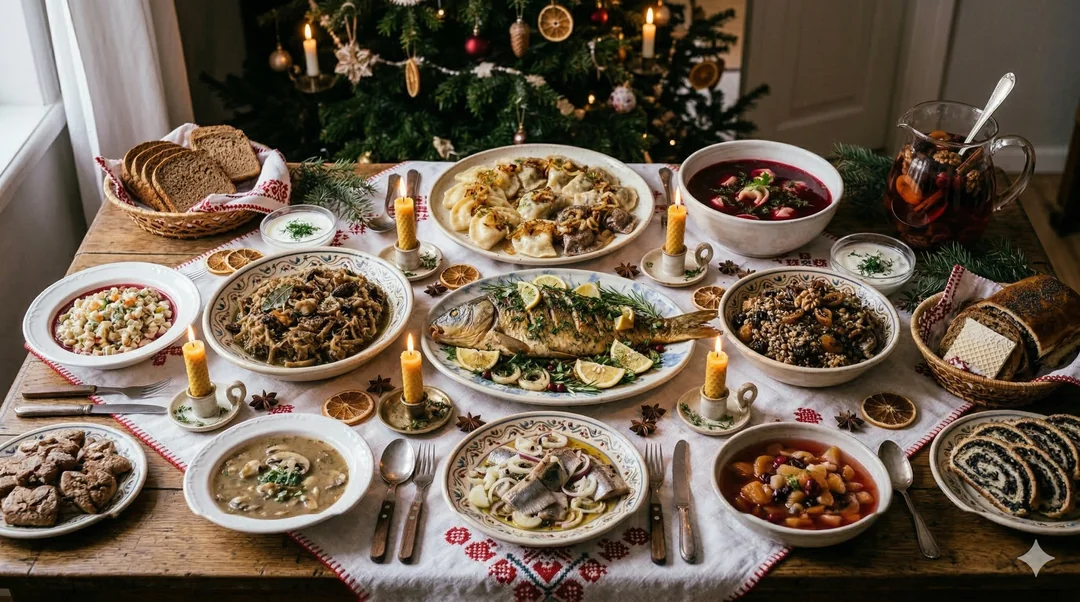
Food is teachable without fluency. You learn pierogi by hand, not by textbook. You learn not to count them while you fold — a superstition many Polish-American families still observe. You learn barszcz with uszka, kapusta z grzybami, karp, makowiec, chrusciki. These dishes became the curriculum for identity.
The table as altar: Wigilia
Nothing carries more weight in the consulate interview than Wigilia, because it bundles Catholic faith, family hierarchy, and hospitality into one night.
- Waiting for the first star. The youngest child watches the sky. Only when it appears does the meal begin.
- Hay and an empty place. Hay under the white cloth recalls the manger. An extra setting is left for the unexpected guest, "because Jesus comes to us as the unexpected guest".
- Twelve meatless dishes. For the twelve apostles, no meat — "animals are given the night off".
- Opłatek. The wafer, often stamped with the Virgin Mary, is passed around. Each person breaks a piece from another's wafer, eats it, and offers a personal wish for the coming year. It turns a Catholic communion symbol into a family reconciliation ritual.
- Three generations cooking. Children watch, then do. "Everything is rooted in generations and meals are prepared together".
After Wigilia, families walk to Pasterka, Midnight Mass — the same Mass your ancestors attended in Poland, now sung in Polish in Chicago, Buffalo, or Los Angeles.
Easter in a basket: Święconka
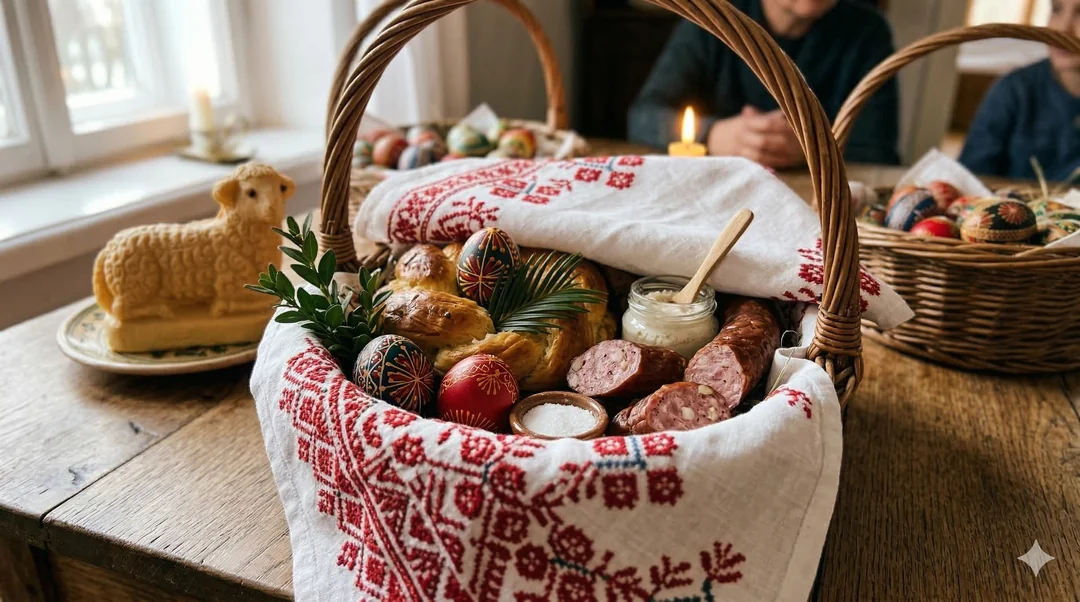 If Wigilia is home, Święconka is public. On Holy Saturday, Polish Americans bring baskets to church, lined with white linen and boxwood, to be blessed.
The contents are a catechism you can taste:
- eggs for life and resurrection
- bread for Jesus
- lamb for Christ
- saltfor purification
- horseradish for bitter sacrifice
- ham for joy and abundance
The practice dates to the early Middle Ages, possibly from pagan spring rites, and in the U.S. older Polonia families still bring whole hampers to parish halls. In places like Greenpoint, Brooklyn or Los Angeles' Our Lady of the Bright Mount, the line for blessing stretches around the block — in English, Polish, and Spanglish.
Parish life: the other Poland
For immigrants who could not read Polish newspapers, the parish was Poland. St. Florian in Hamtramck, St. Stanislaus in Buffalo, St. John Cantius in Chicago — these churches preserved language through hymns, records through baptismal books, and community through sodalities.
That is why religious practice counts so much for Karta Polaka. It is not only belief, it is continuity. Midnight Mass, Gorzkie Żale during Lent, May devotions to Mary, and the image of Matka Boska Częstochowska on the living room wallkept a national symbol alive when Poland did not exist on maps.
Rituals beyond the calendar
- Imieniny (name days). More important than birthdays for many families. You celebrate your patron saint, not just yourself.
- Weddings: oczepiny. The unveiling ceremony, the bread-and-salt welcome, the polka that lasts until 2 a.m.
- Dyngus Day. On Easter Monday, Buffalo turns into the world's largest Polish street party — water fights, pussy willows, polka bands, and yes, pierogi and kielbasa on every corner. It started as Śmigus-Dyngus, a fertility rite, and became an American assertion: we are still here.
- Zaduszki (All Souls' Day). Visiting cemeteries, lighting znicze, cleaning graves — even in American cemeteries, Polish sections glow on November 1.
What this means for your Karta Polaka story
The consulate does not expect perfect Polish. The law asks for "basic knowledge of Polish and knowledge and cultivation of Polish traditions." That second part is where diaspora families shine.
When you prepare for the interview
- Name one food and when you eat it, not just what it is.
- Describe one religious custom your family kept in America (Wigilia opłatek, Święconka basket, Pasterka).
- Connect it to a place: the parish, the Polish market, the basement where babcia rolled dough.
Language can fade. If you can explain why you still set an extra plate on Christmas Eve, or why you bless eggs in April, you are already demonstrating the "związek zpolskością" the card is meant to recognize.
Updated May 2026. This guide synthesizes primary-source reporting from southeast Michigan's Polish parishes (interview with Fr. Mirosław Frankowski, St. Florian Parish, via Catholic News Service), the Polish American Congress Święconka documentation, USC Digital Folklore Archives on opłatek practice, and Deborah Anders Silverman's Oskar Halecki Award-winning book Polish-American Folklore (University of Illinois Press, 2000) based on 200+ interviews since 1978. Reviewed by the KartaPolaka editorial team for applicants documenting "cultivation of Polish traditions" under Article 4 of the Karta Polaka Act.